
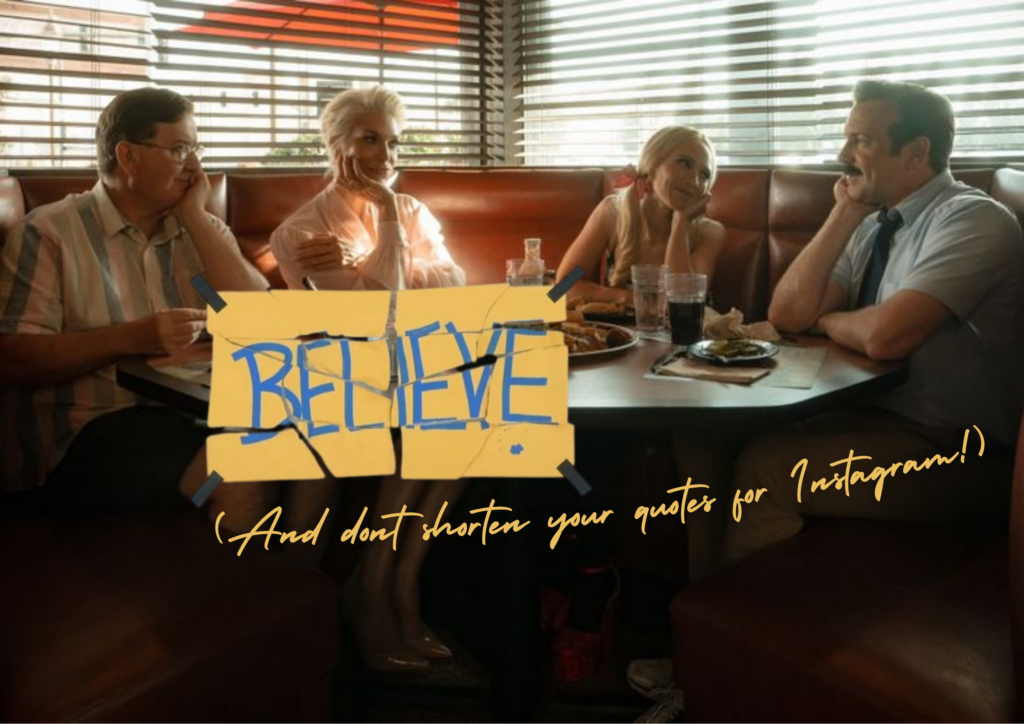
Remember THAT quote from Ted Lasso? (Please tell me in the comments which one you thought of.) The one I’m talking about is where Beard isn’t willing to forgive Nate and Ted tells him:
“I hope that either all of us or none of us are judged by the actions of our weakest moments, but rather by the strength we show when and if we’re ever given a second chance”
I recently encountered that quote on Instagram in a “favorite quotes” post, but it looked like this: “I hope that none of us are judged by the actions of our weakest moments, but rather by the strength we show when and if we’re ever given a second chance”.
Oops. That’s not what Ted was saying.
Because omitting the “either” gets rid of the most important facet of that quote. It isn’t about being naive. Ted Lasso often gets accused of that, but he really isn’t. He’s just a radical optimist, seeing where our world could be better.
Saying “I don’t want any of us judged” would be naive. Judgement happens, it is human nature. Our brains crave categories and they crave to sort people’s behavior into ‘acceptable’ and ‘unacceptable’. It is very unlikely, that none of us will be judged ever again. And it is very unlikely for Beard to respond well to Ted telling him “don’t judge”.
What the “either”-part of that quote does so cleverly is, it holds up a mirror. It silently asks Beard “by what standard would you like people to judge you?” and leaves the answer up to him. Because you can’t judge someone else but not yourself. You can’t judge someone and ask not to be judged by others. At least not, if you’re aspiring to be a good person.
Because essentially, there are two moral systems on offer:
Number one is, we are what we did at our worst.
Okay.
If you live by that, it’s true for the friend who betrayed you, the coworker who behaved badly and the celebrity, who said something shitty to you eight years ago.
And you.
Or number two: People can be more than the worst thing they’ve done, provided what they do next gives us reason to believe they’ve changed.
Then Nate gets that possibility.
And so do you.
And that is exactly what the Instagram quote accidentally removes: It turns reciprocity into mercy. Ted isn’t saying “be nice to Nate”. He’s saying “apply your rules consistently.” Beard isn’t being asked to extend some abstract kindness, he is being reminded that he himself lives inside someone else’s second chance.
And boy do we need that reminder, especially in the online space.
We are incredibly good at contextualizing our own behavior. I was traumatised. I was young. I didn’t know better. I was struggling. You don’t understand what was happening behind the scenes.
But when someone else messes up (especially someone we don’t like) we quickly turn into prosecutors. And conversely, there are people who weaponize „everyone makes mistakes“ to avoid accountability.
That is why the original quote is so good: It doesn’t let either group off the hook. It isn’t “everybody deserves forgiveness”, it is “A second chance gives you an opportunity to provide new evidence about who you are.”
A second chance is not the same as absolution
You can absolutely believe that someone is capable of doing better in the future without pretending they didn’t hurt you. You can give someone a second chance without giving them unlimited chances and you can believe people shouldn’t be permanently defined by their worst moment while still believing that moment belongs to their story. But also: nobody is necessarily entitled to your forgiveness just because they’ve changed.
The moral of the story isn’t “People are good”, it is “People are capable of being better than they were yesterday.” And doesn’t that take off so much pressure? On both sides?
Now, to put some of that pressure back on, let’s go back into that quote.
Because what happened here is a perfect example of how internet quote culture works: we turn complicated ideas into palatable affirmations.
Don’t judge.
Protect your peace.
You don’t owe anyone anything.
If they wanted to, they would.
Pretty comforting, pretty useful, pretty morally useless, when stripped of context and reciprocity. (There’s a whole other article in the lack of reciprocity of ‘if they wanted to, they would’. Maybe tomorrow.”)
We love wisdom once we’ve edited out the bit that makes demands of us. But sometimes, he most important word in a sentence is the one that stops it being entirely about everybody else.