
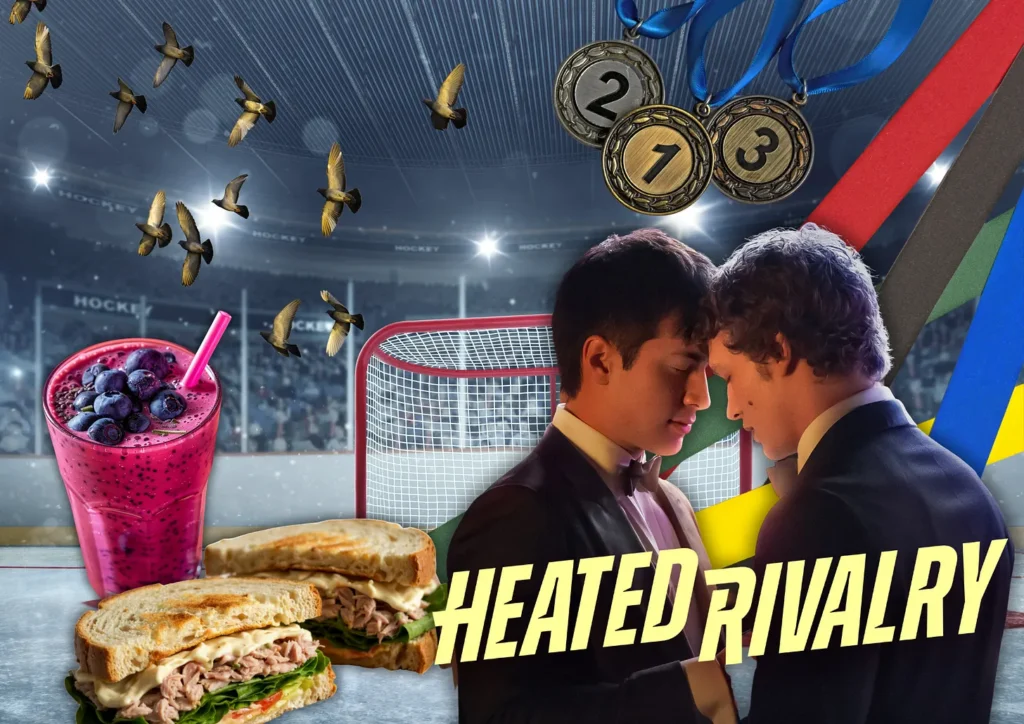
Disclaimer: This article contains massive spoilers for all episodes of Heated Rivalry. Please only read if you don’t mind!
Yes I watched it. Of course I did. Binged it in two nights, actually. And I loved it. The casual representation, the friendships, Ilya Rozanovs biting sarcasm and other prominent … assets, it is a good show. But I couldn’t help but wonder … have showrunners become too nonchalant to explain what needs explanation? (Yes, grew up on SatC, my inner Carrie still stirs sometimes, I promise to reign her in. Please stay with me here.)
Shane Hollander and Ilya Rozanovs hate-to-sex-to-love-story is trailblazing in its success, definitely. Primarily because queer lovestories are wildly underrepresented in pop culture. Especially gay men don’t really get love. They get to be the funny best friend, the shoulder to cry on, the stylist. They are the wild and adventurous flirt or the fussy gay dads, discovering being gay as part of their midlife crisis. To have a whole series follow queer, young couples in love is a relatively new thing in mainstream media. And representation matters, obviously.
Now, I love the way things are normalized in Heated Rivalry. It is simply a regular romantic series, no extra queer-signalling needed. It’s just normal relationships. And I feel like that is a breath of fresh air in a world where anything queer is always a huge statement. Also, I love that Shane being on the spectrum is just hinted at and not a huge plot point. However, don’t you wish we’d gotten a little more talk about the feelings?
Its all warm and fuzzy, but do we ever talk about feelings?
Yes, both Ilya and Shane and Scott and Kip talk about the hardships of coming out as a professional hockey player. Ilya talks about Russia and his parents. But THATS IT. And thats just general facts. You can’t be gay in Russia. You’re better not gay as a pro hockey player. Dementia is shit, so is being used as a bank by your brother. Losing your mom at 12 years old is devastating.
We see what happens to them.
We’re told why it’s difficult.
But we’re rarely invited into how it actually feels.
Maybe the emotional restraint is part of the overall nonchalance. A refusal to turn queerness — or pain — into a spectacle. Perhaps not naming every feeling is the show’s way of saying: this doesn’t need to be justified.
Is the absence of actual, personal feelings a gap or a gesture?
Heated Rivalry is making the stakes very clear. Rozanov faces actual death in his home country. Scott Hunters coming out might ruin his teams chances of winning the Stanley Cup. But WHAT. DO. THEY. THINK?
When does Shane fall in love, when does it change for Ilya, why does Scott decide to come out as publicly as he could have?
And then … and then I cringe. Because that thought is exactly the one we’re not supposed to have, right? We’re not supposed to pry for more insight, more explanation. Emotions are valid, even if we don’t see or understand them. How can I watch cocky Ilya Rozanov cry in the arms of his lov … sorry, boyfriend and ask for even more? I feel like in watching a series, I’m owed that insight, but am I? Or am I just conditioned to think so by years and years of over-explaining, exposing stuff that should never be exposed, naming and cataloguing every tiny thing.
Does good filmmaking have to answer every question?
Would it be more caring, more generous, to name the emotions out loud? To guide the viewer through the fear, the grief, the anger and the tenderness, especially in a story that carries so much weight, both personally and politically?
Or is restraint the point?
The series is remarkably nonchalant about things that, in other hands, would become statements. Being queer isn’t framed as a constant problem to be solved. Pain isn’t always turned into a lesson. Because not always having an answer, well that’s just life. Maybe the refusal to spell out every feeling is part of the same move, a way of not making identity (or suffering) a performance for the audience.
I’m not sure whether I wanted the show to take me by the hand more, or whether I appreciated that it didn’t.
Maybe there’s something in being trusted to do the feeling myself.